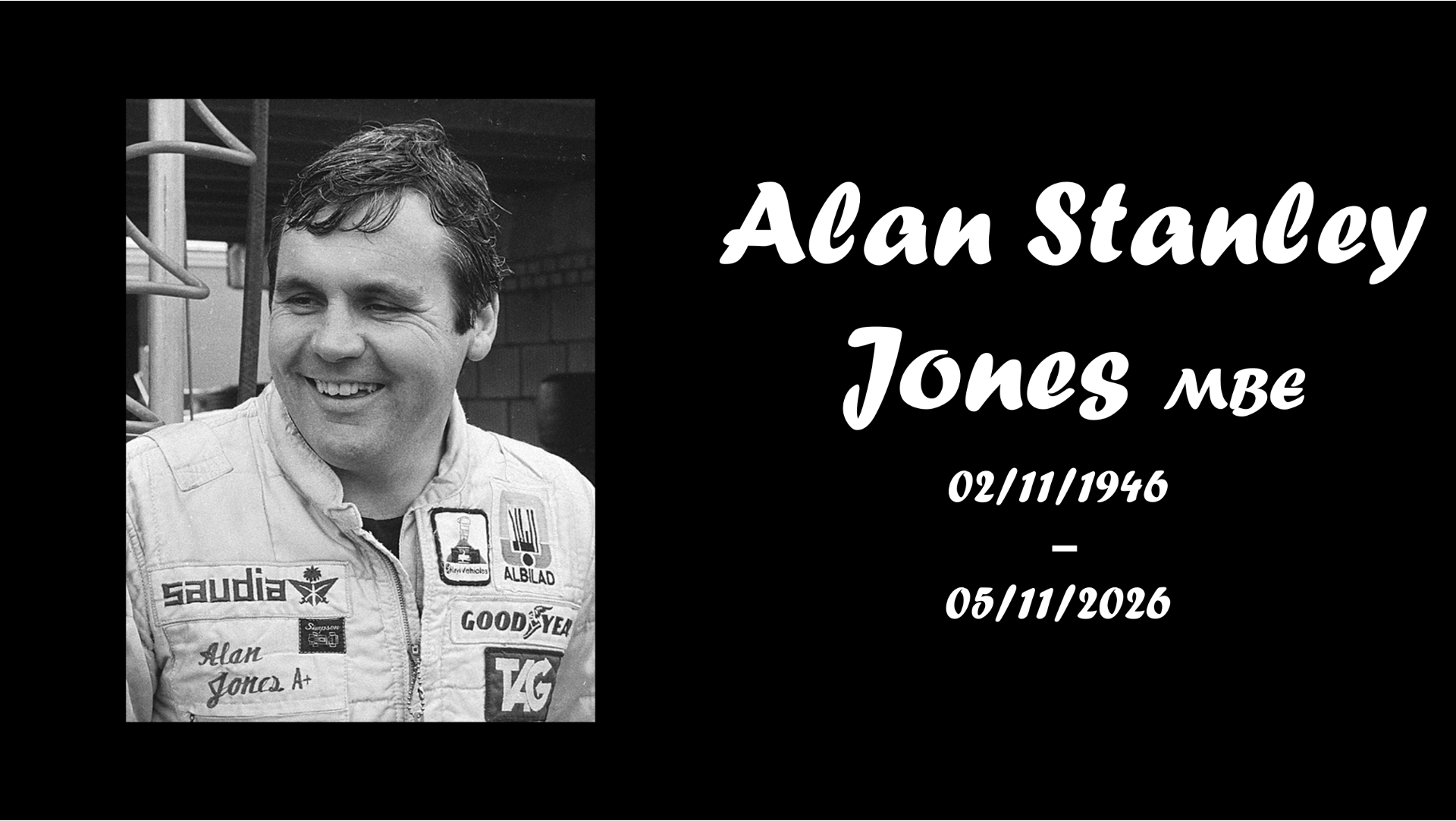
Alan Jones MBE, the last Australian and first Williams driver to win the F1 world title, died at 80. Jones raced in F1 between 1975 and 1986, winning the title in 1980 to become the first of Williams’ seven world champions.
Jones, who celebrated his birthday on Monday, died following a short illness, the family confirmed through Motorsport Australia. Jones was only the second Australian to win the championship after Sir Jack Brabham, and topped the podium at 12 Grands Prix during a career that took in spells with Hesketh, Williams – with whom he won his title – and Arrows.
A statement from his wife, Amanda Butler-Jones, via Motorsport Australia, the country’s national governing body, read, “We are extremely saddened to announce the passing of our beloved Alan, who passed away on 5 November following a short illness.”
“He will be dearly missed and fondly remembered by those closest to him, as well as the many fans whose support he was always grateful for. Alan dedicated his life to motorsport, building a legacy that will live on through the countless people he touched along the way.”
Jones made his first race start in Barcelona at the 1975 Spanish Grand Prix with Hesketh, taking his first win at the Red Bull Ring, as it’s now called, with Shadow in 1977.
Jones was born in Melbourne in 1946, the son of businessman and racer Stan Jones, and watched from the sidelines as his father won the 1959 Australian Grand Prix; he would go on to win the race in 1980, pre-World Championship era, and remains the last Australian to win it.
He settled in London in the 1970s permanently and began racing in F3 before taking his first win at Silverstone in F3, before finishing as runner-up in the championship in 1973.
In 1975 he made his debut at the Spanish Grand Prix, in a Hesketh, and when that team shut at the end of the season he moved to Graham Hill’s team, then to Surtees. That team also was too close and Jones’s career looked to have stalled – until Shadow called, having lost lead driver Tom Pryce in a tragic crash in South Africa.
In a fairytale result, Jones won in Austria, after a brilliant drive on a wet track, passing local hero Niki Lauda on the way to the first win for an Australian since the retirement of Sir Jack Brabham.
Jones was a favourite of Sir Frank Williams and Sir Patrick Head, taking their first podium at Watkins Glen in 1978, followed by the first pole at Silverstone the following year. This laid the foundations for his championship in 1980.
. In the US Grand Prix, he was second to Carlos Reutemann’s Ferrari while a new car, the FW07, was being finished back at Grove. Once Jones and new team-mate Clay Regazzoni got their hands on the car, they looked like winners nearly immediately.
Jones led by a mile at Silverstone until a water pump failed, allowing the Swiss to take the team’s maiden victory. Jones then took over, winning four of the remaining six GPs, to take third in the championship, behind Jody Scheckter and Gilles Villeneuve.
Jones won five Grands Prix in 1980 — Argentina, France, Britain, Canada and the USA — to claim the world title, topping off the year with the non-championship wins in Australia and Madrid.
The following season, he was beaten to the title after a series of wins by teammate Nelson Piquet and only took two wins in Long Beach and Las Vegas, but saw mostly retirements, with him announcing his retirement at the end of the season.
He returned to Australia for a year, before a one-off race for Arrows at Long Beach in 1983, Jones then did three races and the full 1986 season with Beatrice-Haas then retired at the end of that season. A car designed by a then unknown Adrian Newey.
Jones then raced in touring cars, sports cars, CART and Le Mans, before retiring from motorsport following Bathurst in 2002. A broadcasting career followed as a commentator for Australian TV, developing a reputation for calling things as he saw them.
He also did some work in recent years as a driver steward for the FIA. Hew wsas awarded an MBE by Queen Elizabeth in 1980, inducted into the Sport Australia Hall of Fame in 1985.
He is survived by his wife and his six children, Christian, Amber, Zara, Jack, Camilla and Emma